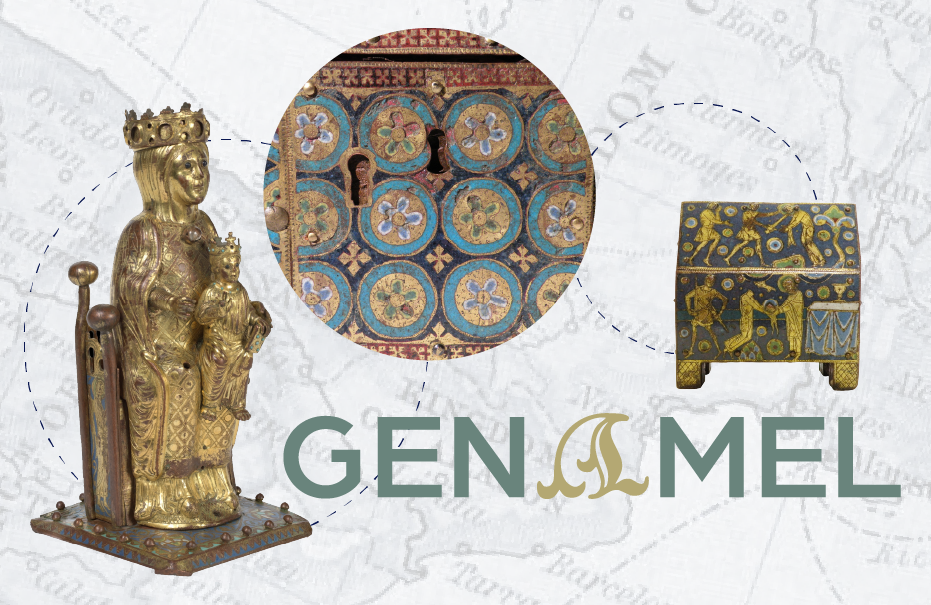
Género y esmaltes medievales en colecciones en España, circa 1150-1300 (Gender and Medieval Enamels in Spanish Collections, ca. 1150-1300)
Acrónimo: GENAMEL
Centro de ejecución: Departamento de Estudios Medievales, Centro de Ciencias Humanas y Sociales, CSIC
Referencia del proyecto: PID2024-162926NB-I00
Convocatoria y Organismo Financiador: Proyecto del Plan español de investigación, Ministerio de Ciencia, Innovación y Universidades, Proyectos de generación de conocimiento 2024.
Período de ejecución: 1/9/2025 a 31/8/2029
[ES] La hipótesis de GENAMEL es que un enfoque de género de los esmaltes de los siglos XII y XIII de las colecciones españolas permitirá comprender mejor el modo en que los medievales se relacionaban con estos objetos en espacios que a menudo estaban marcados por el género. Esto, a su vez, ayudará a explicar la enorme popularidad de los esmaltes medievales, que se producían casi en masa, y contribuirá a crear un marco para investigar otros tipos de obras de arte medievales.
GENAMEL echa un nuevo vistazo a un tipo de objeto familiar a través de una lente inesperada: el género como enfoque de los esmaltes medievales anónimos, que en los siglos XII y XIII eran muy apreciados. Nos preguntaremos cómo puede llevarse a cabo de forma fructífera un enfoque de género para objetos que, como los esmaltes, apenas llevan rastro de su fabricante o propietario, ya sean mujeres u hombres. De hecho, dado que la mayoría de los esmaltes fabricados en Francia y la Península Ibérica en los siglos XII y XIII están relacionados con catedrales y monasterios y proceden de tierras gobernadas principalmente por reyes, se ha asumido que estos objetos fueron encargados, utilizados, transportados y regalados por hombres. Pero, ¿significa esto que las mujeres medievales no se dedicaban a los esmaltes? ¡Pues no! Utilizando un enfoque de género de analizar la iconografía, la función y el uso de los esmaltes y otros objetos metálicos (tanto reales como representados en manuscritos), así como las fuentes medievales y la historiografía sobre los esmaltes, mi equipo altamente cualificado de estudiosos senior y más junior, demostrará los múltiples niveles en los que también las mujeres interactuaron con los esmaltes durante la Edad Media central.
[EN] The hypothesis of GENAMEL is that taking a gendered approach to twelfth- and thirteenth-century enamels in Spanish collections will lead to a fuller understanding of how medieval people engaged with these artefacts in spaces that were often gendered. This, in turn, will help to explain the enormous popularity of medieval enamels, which were nearly mass produced, and it will contribute to a framework for investigating other types of medieval artworks.
GENAMEL takes a new look at a familiar type of object through an unexpected lens: gender as an approach to anonymous medieval enamels, which in the twelfth and thirteenth centuries were widely appreciated. We will ask how a gendered approach can be fruitfully carried out for objects, like enamels, that bear little trace of maker or owner, whether women and men. In fact, because the majority of surviving enamels made in France and the Iberian Peninsula in the twelfth and thirteenth centuries are associated with cathedrals and monasteries (that is, male-dominated ecclesiastical institutions) and originated in the lands ruled mainly by kings, the general assumption has been that these artefacts would have been commissioned, used, transported, and gifted by men. But does this mean that medieval women did not engage with enamels? Indeed, no! Using a gendered approach when analysing the iconography, function, and use of enamels and other metal artefacts (both real and represented in manuscripts) as well as medieval sources and the historiography on enamels, this project will demonstrate the multiple levels on which women too interacted with enamelled objects during the central Middle Ages.
Investigadora principal
Jitske Jasperse, Tenured Researcher at the Instituto de Historia, CSIC
Miembros del proyecto
Therese Martin, Research Professor at the Instituto de Historia, CSIC
Beatriz Campderá Gutiérrez, Senior Curator of the Departamento de Antigüedades Medievales at the Museo Arqueológico Nacional, Madrid
Josefa Gallego Lorenzo, Tenured Professor at the Universidad de León
Pamela Patton, Director of the Index of Medieval Art, Princeton University
Luis Rueda Galán, Mellon Postdoctoral Fellow at the Meadows Museum, Dallas
Claire Carson Dwyer, PhD Student at Columbia University
Amaya Pérez Almenara, PhD Student at the Instituto de Historia, CSIC and Complutense Universidad de Madrid